Why CRM Implementation in the UAE Still Fails — And How to Fix It
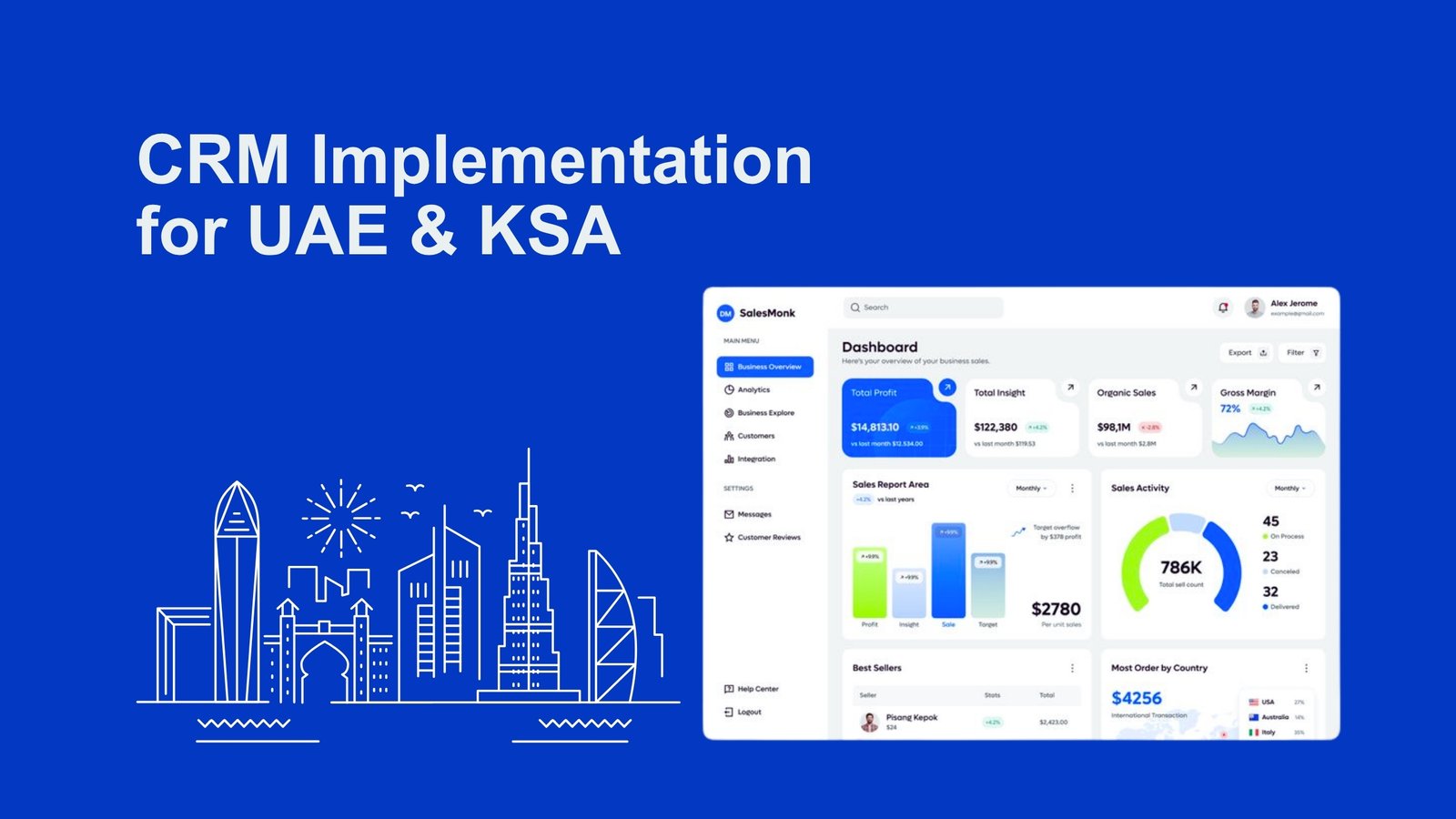
A mid-market company in Dubai invested heavily in a new CRM. Leadership promised real-time
pipeline visibility within 90 days, and the demo looked the part — clean reports, convincing forecast
charts, polished dashboards.
Three months later, the reality was different. Sales reps were still tracking leads in spreadsheets,
marketing questioned the campaign data, and finance was manually reconciling customer records
between systems. The CRM was technically live but operationally ignored.
This pattern repeats across the UAE and the wider GCC. CRM implementation projects rarely fail because of the technology — they fail because organisations treat the rollout as an IT task instead of a business transformation. This guide breaks down the seven most common reasons CRM projects fail in the region, and exactly how to fix each on
Key takeaways
- Failure is common and predictable. Industry studies put CRM failure rates between 30% and 70%, with several recent analyses converging around 50–55% — and poor user adoption is consistently the number-one cause.
- It’s rarely the software. The same CRM platform can hit 95% adoption at one company and stall at 40% at another. The difference is strategy, data, and change management.
- The four foundations of success: clear business objectives, disciplined data governance,
seamless ERP integration, and sustained user adoption. - Regional factors matter. Multinational teams, multi-emirate branches, VAT compliance, and multicurrency GCC operations all raise the stakes for getting implementation right.
The 7 reasons CRM projects fail (and the fix for each)
| # | Why it fails | How to fix it |
|---|---|---|
| 1 | No business case before choosing software | Define measurable KPIs first; let strategy drive system design |
| 2 | User adoption is underestimated | Treat adoption as behavioural change, not one-off training |
| 3 | Poor data governance during migration | Cleanse and assign ownership before you migrate |
| 4 | Over-customization | Start standard; customize only where it pays off |
| 5 | ERP integration ignored | Design integration into the core architecture |
| 6 | Industry-specific needs overlooked | Configure for your vertical and region |
| 7 | Automation without strategy | Automate clean processes, not broken ones |
1. Choosing software before defining the business case
Many organisations start a CRM project by comparing vendors — asking “which platform is best?”
before asking “which business outcome must improve?” Without defined objectives, even the most
capable platform struggles to create measurable value. Technology gets deployed, dashboards appear,
and data accumulates, but the business impact stays unclear.
How to fix it: Define measurable KPIs before you select technology — for example, shorten the sales cycle, improve forecast accuracy, increase customer retention, accelerate quote-to-cash, or improve service response time. A clear strategy should guide system design. Technology follows business goals, not the other way around.
2. Underestimating user adoption
A CRM that employees don’t use is just an expensive database. Adoption is the single biggest predictor
of success — and the most common point of failure. Research cited across the industry consistently
names poor user adoption as the leading cause of CRM failure, and according to CSO Insights, fewer
than 40% of CRM customers achieve end-user adoption above 90%. Really Simple Systems has
reported that 83% of senior executives say their biggest challenge is simply getting staff to use the
software.
Adoption is harder in the UAE for structural reasons: multinational teams bring different workflows,
branches are distributed across emirates, and fast-growing organisations have processes that keep
changing. Technology alone cannot solve a behavioural problem.
How to fix it: Drive adoption through structured engagement — design role-based workflows so the CRM fits how each team actually works, tie CRM usage to employee KPIs, track adoption weekly, and train with real business scenarios rather than generic feature tours. Adoption is sustained behavioural change, not a one-time event.
3. Weak data governance during migration
Data quality determines whether leadership trusts the system. Teams often migrate unclean data
straight into the new CRM, and the symptoms appear fast: duplicate contacts, incomplete fields, and
inconsistent customer hierarchies. Once executives lose confidence in the data, the system quickly
becomes irrelevant — and you enter the spiral where bad data drives low usage, which produces worse
data.
How to fix it: Strengthen governance before and after go-live. Cleanse and deduplicate records before migration, assign clear ownership for each data object, implement validation rules, and schedule periodic data audits. Strong governance is what protects long-term CRM value.
4. Over-customizing the system
When companies try to replicate every legacy workflow inside the new CRM, they end up with
excessive customization, tangled automation layers, and heavy dependence on administrators. Overengineered systems slow innovation and inflate maintenance costs.
How to fix it: Favour a simplified architecture. Start with standard CRM processes, customize only where a measurable outcome requires it, and evaluate long-term maintenance cost before approving any modification. Simplicity scales; complexity multiplies operational risk.
5. Ignoring CRM–ERP integration
A CRM rarely operates alone. In the UAE, organisations manage VAT compliance, financial reporting, and operational transactions through ERP systems. When CRM and ERP integration is ignored, operational fragmentation sets in: sales sees deals, finance sees invoices, operations sees fulfillment — but no single system reflects the complete customer lifecycle.
How to fix it: Treat integration as core architecture, not an afterthought. Map the full lifecycle — Lead → Opportunity → Quote → Order → Invoice → Delivery → Service — then define ownership: the CRM owns customer relationships, the ERP owns operational and financial processes.
6. Overlooking industry-specific requirements
CRM configuration varies by industry, and a generic setup rarely fits specialised sectors. A real-estate
business in Dubai, for instance, needs property inventory management, broker commission structures,
lead distribution across agents, and developer project tracking. Companies expanding across the GCC also need multi-currency operations, regional compliance, and cross-border reporting. This complexity is where an implementation partner who understands the regional and vertical context earns its keep.
How to fix it: Configure the CRM around your specific industry workflows and regional obligations from day one, rather than forcing a generic template to fit.
7. Automating without a strategy
Automation promises efficiency, and many teams expect instant productivity gains. But automation
applied without strategy creates confusion — and automating a broken process simply multiplies the
inefficiency.
How to fix it: Adopt a focused automation strategy. Automate repetitive administrative tasks, avoid automating processes that aren’t yet well defined, and review automation performance regularly. Good automation simplifies operations; it shouldn’t complicate them.
CRM implementation in the UAE, by the numbers
- Roughly 50–55% of CRM implementations fail to meet their objectives, with user adoption the top cause (recent industry analyses, 2025).
- Fewer than 40% of organisations achieve end-user adoption above 90% (CSO Insights).
- 83% of senior executives say their biggest challenge is getting staff to use the software (Really Simple Systems).
- 91% of companies with 10+ employees use a CRM (Gartner) — adoption of the tool is near universal; success with it is not.
- Done well, CRM returns roughly $8.71 for every $1 spent (Nucleus Research) — which is exactly why failed rollouts are so costly.
How OrkSync supports CRM and ERP implementation in the UAE
Choosing the right implementation partner matters as much as choosing the technology. OrkSync helps
organisations across the UAE and GCC align deployment with measurable business outcomes —
focusing on CRM and ERP strategy alignment, strong data governance frameworks, practical user adoption programs, and scalable integrations, rather than technical setup alone.
Explore OrkSync’s CRM Implementation and ERP Implementation services, or book a free consultation to discuss your project.
Frequently asked questions
01 Why do most CRM implementations fail?
01
Why do most CRM implementations fail?
The leading cause is poor user adoption, followed by a
weak business case, poor data governance, and missing ERP integration. The technology itself is
rarely the problem — implementations fail when treated as an IT project rather than a business change.
02 What is the CRM failure rate?
02
What is the CRM failure rate?
Industry studies cite a wide range of 30% to 70%, with several recent
analyses converging around 50–55% of implementations failing to meet their objectives.
03 How do you improve CRM adoption?
03
How do you improve CRM adoption?
Design role-based workflows that match how teams actually
work, tie CRM usage to KPIs, train with real scenarios, secure visible executive sponsorship, and track
adoption metrics weekly so issues surface early.
04 Should CRM be integrated with ERP?
04
Should CRM be integrated with ERP?
Yes — especially in the UAE, where VAT compliance and
financial reporting run through ERP. Integration gives a single view of the full customer lifecycle and
prevents the data fragmentation that undermines trust in the CRM.
05 How long does a CRM implementation take in the UAE?
05
How long does a CRM implementation take in the UAE?
It depends on scope, data quality, and
integration complexity. A focused rollout with clean data and clear KPIs moves faster; heavy
customization, messy data, and multi-system integration extend the timeline.
Conclusion
CRM implementation fails in the UAE for predictable reasons: organisations underestimate strategy,
overlook adoption, and neglect data governance and integration. Technology alone cannot fix
operational misalignment.
Whether you’re scoping budget, selecting a platform, or choosing an implementation partner across the
GCC, success rests on four foundations — clear strategic objectives, disciplined data governance,
seamless ERP integration, and sustained user engagement. When those align, a CRM stops being just
software and becomes an integrated business-intelligence system that supports long-term growth.