
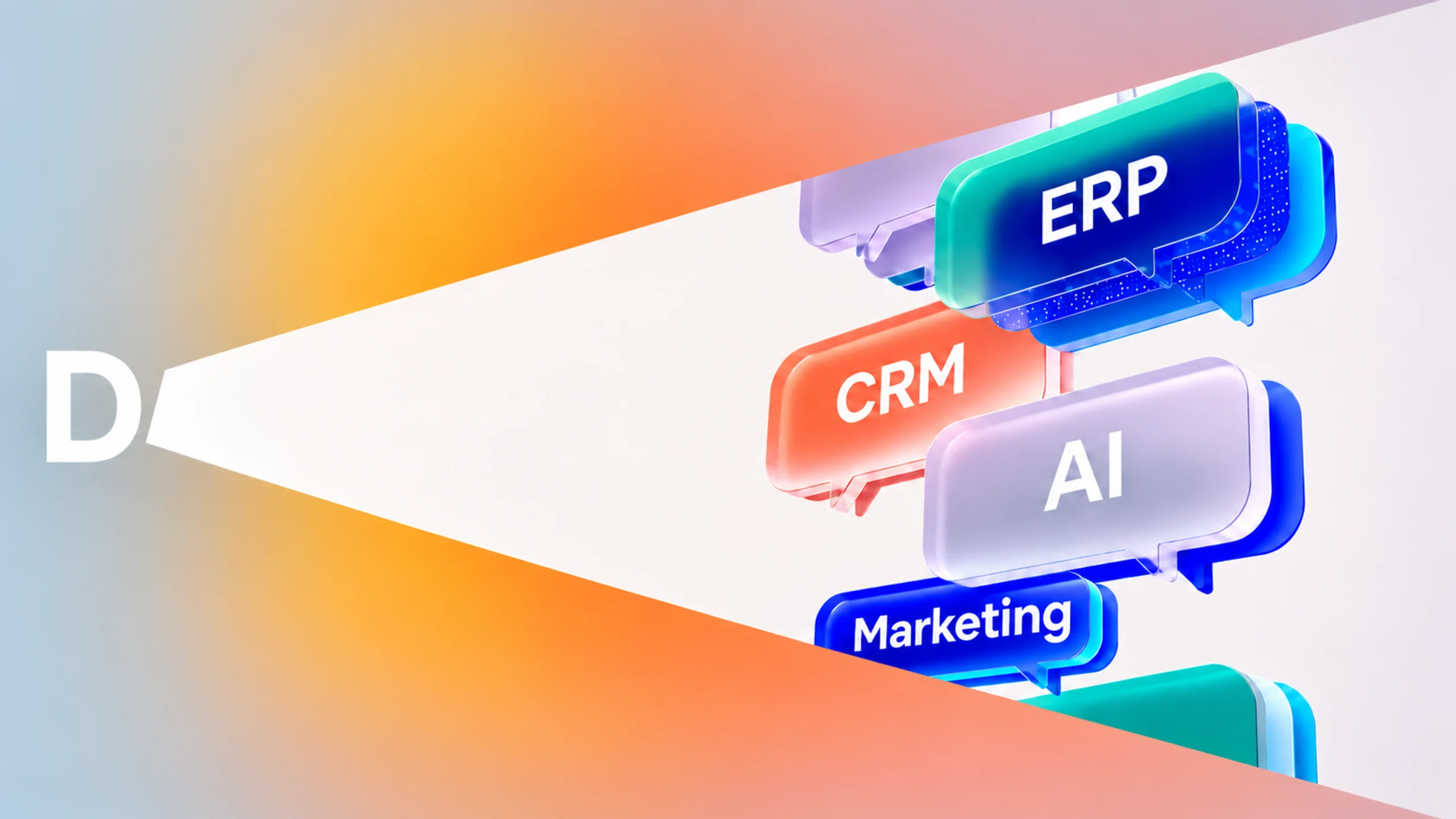
Most business owners in the UAE agree that they need to digitise. The harder question is where to begin. One vendor says you need an ERP. Another pushes a CRM. A third tells you AI will fix everything.
All three can deliver real value. But the order you choose decides whether the project pays off or stalls. This guide explains what each system does, when it should come first, and how to build a digital transformation roadmap that fits your business.
Why the Starting Point Matters in Your Digital Transformation Roadmap
Every digital project depends on the one before it. AI needs clean data. Clean data needs a system that captures it properly. That system needs processes people actually follow.
When businesses skip this chain, problems appear quickly. A CRM goes live, but sales staff keep working in spreadsheets. An ERP launches, but finance and operations still argue over which numbers are right. An AI tool arrives, but it has no reliable data to learn from.
A good roadmap fixes the order. It puts the most painful problem first and builds from there. That is why working with an experienced digital transformation company in Dubai often saves more than it costs. OrkSync’s digital transformation services start with strategy and planning before any software is chosen.
ERP vs CRM vs AI: Quick Comparison
| Factor | ERP | CRM | AI |
|---|---|---|---|
| Main focus | Operations and finance | Sales and customers | Automation and insight |
| Typical pain it solves | Disconnected data, manual reporting | Lost leads, no pipeline visibility | Repetitive tasks, slow decisions |
| Implementation effort | High | Low to medium | Varies widely |
| Time to visible results | Months | Weeks | Weeks, if data is ready |
| Depends on clean data | Creates it | Creates it | Needs it |
Notice the last row. ERP and CRM create structured data. AI consumes it. That single point shapes most roadmaps.
Not sure which column matches your situation? Talk to the OrkSync team and we will help you work it out in a short call.
When to Start With ERP Implementation in UAE
Start with ERP if the operational side of your business causes the most friction. The signs are easy to spot:
- Finance closes the month late because data lives in several files.
- Stock counts never match what the system says.
- Procurement, warehouse, and accounts use separate tools.
- You manage multiple branches or entities and cannot see one clear picture.
- Leadership waits days for a basic profit report.
ERP implementation in UAE also needs to fit local requirements, including VAT handling and Arabic and English documentation. Choose a partner who understands these details, not just the software.
Be realistic about the effort. ERP touches every department, so it takes longer and demands more internal time. Many growing companies phase it in module by module, starting with finance and inventory. If this sounds like your business, see how our ERP implementation service works in practice.
When to Start With CRM Implementation in Dubai
Start with CRM if revenue is your bottleneck. These signs point that way:
- Leads arrive from several channels, and nobody tracks them in one place.
- Sales reps use personal spreadsheets or WhatsApp threads as their pipeline.
- You cannot say how many deals are open or when they will close.
- Follow ups depend on memory.
- Marketing and sales blame each other for poor lead quality.
CRM implementation in Dubai is usually faster and cheaper than ERP. You can often go live in weeks and see results quickly. That makes CRM a strong first step for small and medium businesses that need growth before they need deep operational control.
Ready to bring your pipeline into one system? Explore OrkSync’s CRM implementation service and see what a clean sales process looks like.
When AI Solutions for Business Make Sense (and When They Don't)
AI works best when it targets a specific, repetitive task. Good early use cases include:
- Answering common customer questions through a chatbot
- Summarising and routing incoming emails or enquiries
- Scoring and prioritising leads
- Forecasting stock demand
- Extracting data from invoices and documents
AI does not make sense as your first move if your data is scattered, your processes are undocumented, or nobody owns the outcome. In that case, AI will simply automate the confusion faster.
The better approach is to run AI pilots alongside your core systems. Pick one narrow problem, test it for a few weeks, and measure the result. If it works, expand. If it doesn’t, you have lost little. This is how smart businesses adopt AI solutions in the UAE without betting the budget on hype.
If you want to make your data AI ready before you invest, our AI solutions team can assess where you stand and where a pilot would pay off first.
A Practical Digital Transformation Roadmap for UAE Businesses
There is no single correct order, but this sequence works for most companies:
- Audit your current state. List your tools, processes, and biggest pain points. Talk to the people who do the work, not just management.
- Fix the processes first. Document how work should flow. Software cannot repair a broken process.
- Pick the system that removes your biggest bottleneck. Revenue problem? Start with CRM. Operations problem? Start with ERP.
- Integrate, don’t isolate. Make sure the second system connects to the first. Disconnected tools recreate the old problem.
- Clean and structure your data. Agree on naming, fields, and ownership before adding AI.
- Add AI where it saves measurable time. Start with one use case and track the result.
- Review every quarter. Your needs will change as you grow.
For many SMEs, the practical path looks like this: CRM first for growth, ERP next for control, and AI layered across both. A larger or operations heavy business may reverse the first two steps. The audit tells you which.
Sometimes your needs fall outside what ready made software offers. A custom customer portal, a connected website, or an integration between two systems can close the gap. OrkSync’s website design and development team builds these pieces so your systems work as one workflow.
Mistakes That Derail Digital Transformation Projects
A few errors show up again and again:
- Buying software before defining the problem. Tools should follow the need, not the other way around.
- Trying to do everything at once. Large launches that change everything on one day overload teams and increase risk.
- Ignoring staff adoption. A system nobody uses delivers nothing. Plan training from day one.
- Skipping data cleanup. Migrating messy data into a new system just moves the mess.
- Chasing AI trends. Adopt AI because it solves a defined problem, not because competitors mention it.
- Choosing on price alone. The cheapest quote often leaves out integration, training, and support.
Work With OrkSync on Your Digital Transformation Roadmap
You do not need to solve this alone. At OrkSync, we start by understanding how your business runs today. We then map a roadmap in clear stages: discover, strategise, transform, connect, and grow. Every investment has a purpose and a measurable result.
Whether your first step is a CRM, an ERP, or a focused AI pilot, we help you choose well and build it properly. Ready to plan your next step? Contact OrkSync today to book a free consultation tailored to your business.
Frequently Asked Questions
What is a digital transformation roadmap?
A digital transformation roadmap is a step by step plan that shows which technology changes your business will make, in what order, and why. It links each project to a business goal, such as faster reporting or more closed deals. A clear roadmap stops you from buying tools that do not fit together.
Should I implement ERP or CRM first?
It depends on where your biggest bottleneck sits. If you lose leads and struggle to track sales, start with CRM. If your finance, inventory, and operations run on disconnected tools, start with ERP. Many small and medium businesses begin with CRM because it is faster to launch.
Can I start with AI before ERP or CRM?
You can, but only for a narrow task such as a customer chatbot or document extraction. Broad AI projects need clean, structured data, and ERP and CRM systems are what create that data. Starting with AI alone often leads to weak results.
How long does ERP implementation take in the UAE?
The timeline depends on your size, the number of modules, and how clean your data is. A phased rollout that begins with finance and inventory is usually quicker than launching every module together. A good provider will give you a realistic schedule after an initial assessment.
How long does CRM implementation take in Dubai?
CRM projects are usually shorter than ERP projects, and many businesses go live within weeks. Setup time grows if you need custom workflows, many integrations, or a large data migration. Training your sales team early helps the system stick.
How much does a digital transformation project cost?
Cost depends on scope, the systems involved, the number of users, and how much customisation you need. A phased approach spreads the investment and lets you see results before you commit to the next stage. OrkSync shares its engagement options on the pricing page.
Is digital transformation only for large companies?
No. Small and medium businesses often gain the most, because a CRM or a simple automation can free up hours every week. The key is to start with one clear problem and grow from there, rather than copying what a large enterprise does.
How do I choose a digital transformation partner in the UAE?
Look for a partner that begins with your business problems, not a product demo. Ask how they handle integration, data migration, staff training, and support after launch. Check that they have real experience with ERP, CRM, and AI together, so your systems are planned as one connected whole.